
Why InnerHug Created a Community for Your Thoughts
In a world obsessed with "personal branding" and curated social media feeds, we have become experts at performing our lives rather than living them. We post the vacation photos, the job promotions, and the perfectly plated dinners. But what happens to the thoughts that don’t fit the aesthetic? What happens to the "Hinglish" anxieties that we can’t even explain to our closest friends?
In the Indian context, the pressure to maintain a "happy" family image and a successful social status is a heavy burden. We are taught from a young age that our private struggles are meant to stay behind closed doors. But those closed doors often become the walls of a mental prison.
This is why we built the Midnight Wall at InnerHug. It’s not just a feature; it’s a cultural rebellion. It is a space designed to dismantle the fear of judgment by giving you the ultimate shield: Complete Anonymity.
1. The Psychology of the "Ghost" Persona
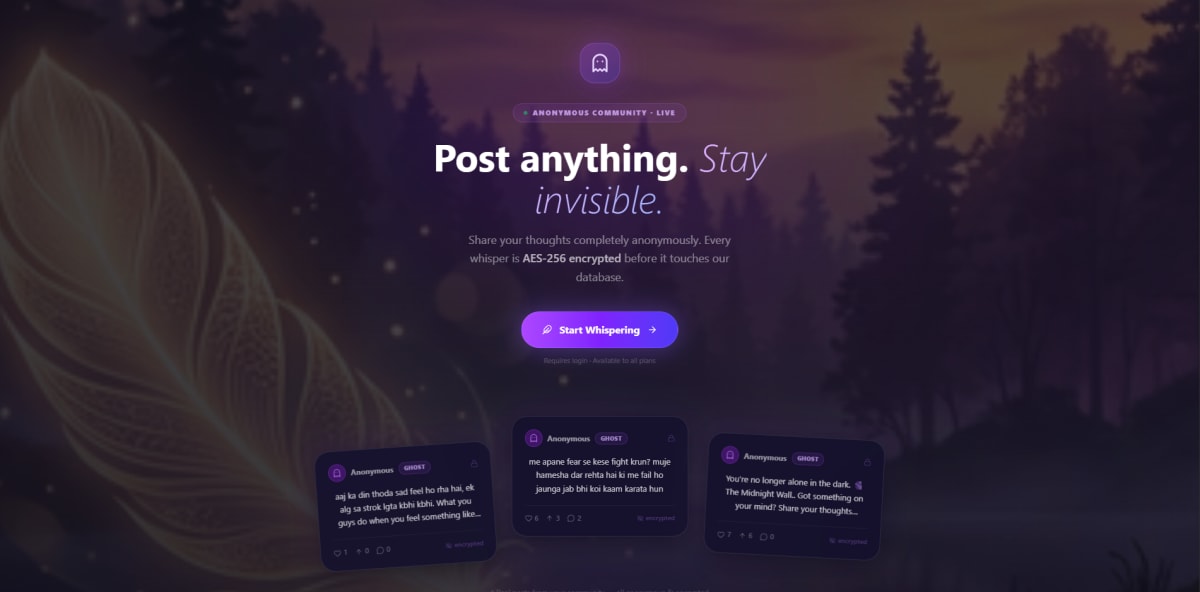
In our platform, you’ll notice that every user in the community is labeled as a "GHOST." This wasn't a random design choice. In traditional social media, your name and face are your "anchor." Every word you type is attached to your history, your job, and your family's reputation. This creates a "filtered" version of the truth.
By becoming a "Ghost" on InnerHug, you are untethered. Psychology calls this the "Online Disinhibition Effect." When the fear of social consequences is removed, people are more likely to:
Share deep-seated traumas without shame.
Ask "silly" questions about mental health they were too afraid to ask a doctor.
Offer genuine, raw empathy to strangers.
You are simply a human being with an emotion. And that is the most honest state a person can be in.
 2. Breaking the Barrier
The biggest barrier to mental wellness in India isn't just a lack of resources, it's the social stigma. We worry that if we admit to feeling "sad for no reason" or "fear of failure" ("me apane fear se kese fight krun?"), people will think we are weak or "ungrateful."
Midnight Wall creates a loophole in this cultural conditioning. Because no one knows it’s you, "Log Kya Kahenge" loses its power.
The Global Feed becomes a mirror. You scroll through and see someone else saying exactly what you were thinking at 4 PM while sitting in a meeting or a classroom.
The Validation: When you see 6 hearts on a post about feeling lonely, those aren't just likes. They are 6 people saying, "I feel you, and you aren't crazy for feeling this."
3. The Power of the "Whisper" vs. The "Post"
Words matter. On other platforms, you "post," "tweet," or "status update." These feel loud, permanent, and demanding of attention.
We chose the term "Whisper" because emotional honesty doesn't always need to shout. A whisper is intimate. It’s what you say when you trust someone.
Instead of writing a long, rambling essay that feels overwhelming to start, we ask you: What is whispering inside you right now? This constraint forces clarity. It helps you identify the core emotion be it anxiety, grief, or a sudden stroke of hope.
4. Safety in the Shadows: Our "Whisper Rules"
Anonymity can sometimes be a double-edged sword on the internet. We’ve all seen comment sections turn toxic. However, we built on a different foundation. Our Whisper Rules are baked into the UI to ensure that while your identity is hidden, your humanity is not.
Kindness over Cruelty: Our community is self-policing and moderated to ensure that support is the default response.
Suggestions, Not Judgments: When someone comments, it’s about offering a hand, not a finger-point.
Ownership of Silence: You have the power to delete your own posts at any time. Your "whisper" stays in the world only as long as you want it to.

5. Bridging the Gap: From Anonymity to Action
While the community is a powerful place to start, we know that sometimes a whisper needs an answer. This is where the InnerHug ecosystem comes in.
The community acts as the "front door." Once a user feels the relief of sharing anonymously, they are often more open to the next steps:
Talking to a Companion: Moving from a public (but anonymous) feed to a private conversation with our AI personas.
Upgrading for Depth: Using the "Core" or "Pro" features to share media or longer reflections when 40 words aren't enough.
The Dashboard Journey: Tracking how their "whispers" change over time—moving from "sadness" to "growth."
A Message to Our Community
To the person who wrote, "aaj ka din thoda sad feel ho rha hai" Thank You. Your honesty gave someone else the permission to feel sad too.
To the person struggling with the fear of failure you are not a "fail" because you are afraid. You are brave because you said it out loud.
At InnerHug, we believe that the brightest light often comes from the things we’ve kept in the dark for too long. Our community is a testament to the fact that even if you feel like a "ghost" in your own life, you are seen. You are heard. And you are definitely not alone.